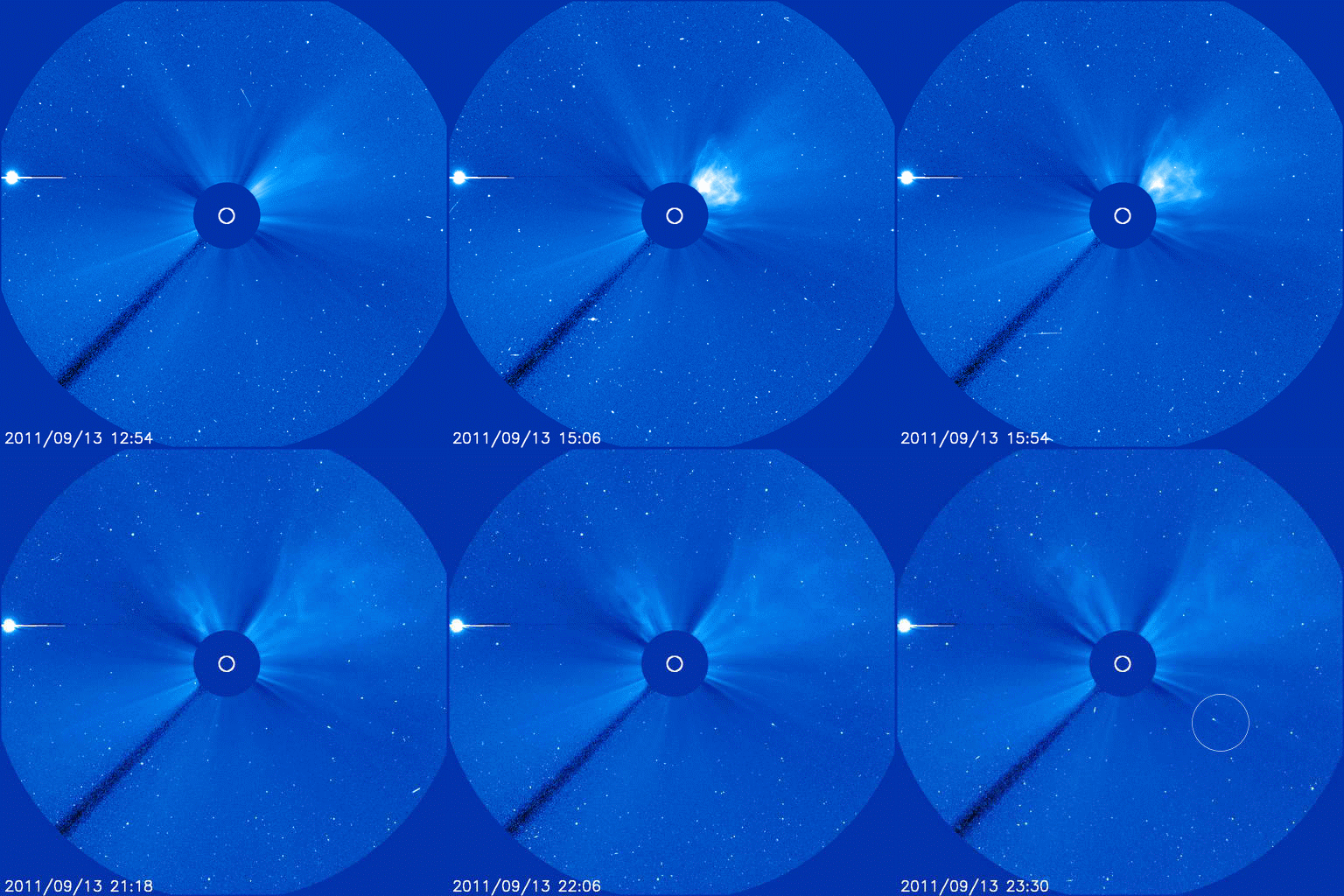
The doomed comet appears to be a member of the Kreutz family. Kreutz sungrazers are fragments from the breakup of a single giant comet many centuries ago. They get their name from 19th century German astronomer Heinrich Kreutz, who studied them in detail. Several Kreutz fragments pass by the sun and disintegrate every day. Most, measuring less than a few meters across, are too small to see, but occasionally a big fragment like this one attracts attention.
Wednesday, September 14, 2011
SpaceWeather.com | SUNDIVING COMET
The doomed comet appears to be a member of the Kreutz family. Kreutz sungrazers are fragments from the breakup of a single giant comet many centuries ago. They get their name from 19th century German astronomer Heinrich Kreutz, who studied them in detail. Several Kreutz fragments pass by the sun and disintegrate every day. Most, measuring less than a few meters across, are too small to see, but occasionally a big fragment like this one attracts attention.
Sunday, April 11, 2010
LASCO C2 - April 5 - 11, 2010 (Comet into Sun 4-10)
http://www.youtube.com/watch?v=nKz8qLInMf8
Tuesday, March 16, 2010
SpaceWeather.com | Comets plunging into sun - Lasco C2 video
Saturday, March 13, 2010
LASCO C2 March 8-13 2010 WITH COMET
http://www.youtube.com/watch?v=JqzONNxVaqA
TheSun.co.uk | Earth under attack from Death Star
AN invisible star may be circling the Sun and causing deadly comets to bombard the Earth, scientists said yesterday.
The brown dwarf - up to five times the size of Jupiter - could be to blame for mass extinctions that occur here every 26 million years.
The star - nicknamed Nemesis by Nasa scientists - would be invisible as it only emits infrared light and is incredibly distant.
Nemesis is believed to orbit our solar system at 25,000 times the distance of the Earth to the Sun.
As it spins through the galaxy, its gravitational pull drags icy bodies out of the Oort Cloud - a vast sphere of rock and dust twice as far away as Nemesis.
These "snowballs" are thrown towards Earth as comets, causing devastation similar to the asteroid that wiped out the dinosaurs 65 million years ago.
Now Nasa boffins believe they will be able to find Nemesis using a new heat-seeking telescope that began scanning the skies in January.
The Wide-Field Infrared Survey Explorer - expected to find a thousand brown dwarfs within 25 light years of the Sun - has already sent back a photo of a comet possibly dislodged from the Oort Cloud.
Scientists' first clue to the existence of Nemesis was the bizarre orbit of a dwarf planet called Sedna.
Boffins believe its unusual, 12,000-year-long oval orbit could be explained by a massive celestial body.
Mike Brown, who discovered Sedna in 2003, said: "Sedna is a very odd object - it shouldn't be there.
"The only way to get on an eccentric orbit is to have some giant body kick you - so what is out there?"
Professor John Matese, of the University of Louisiana at Lafayette, said most comets come from the same part of the Oort Cloud.
He added: "There is statistically significant evidence that this concentration of comets could be caused by a companion to the Sun."
RELATED:
http://spaceweather.com/
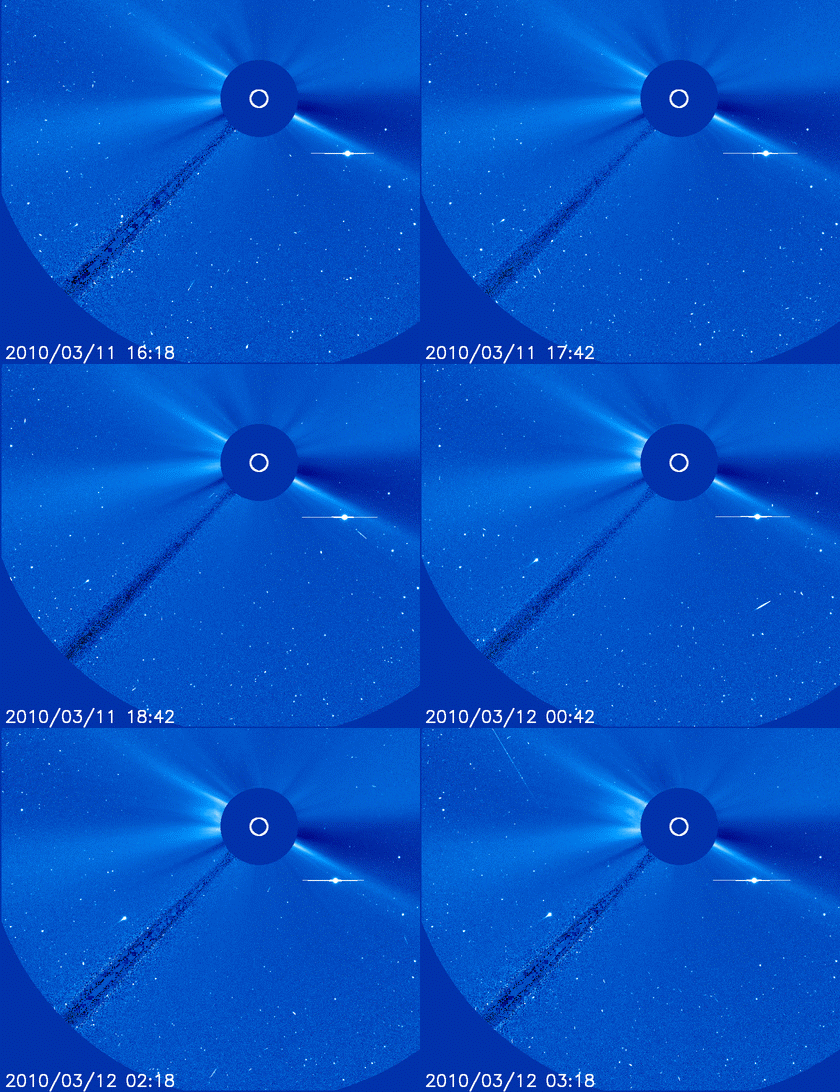
COMET TOAST: The solar system has one less comet. On March 12th, the Solar and Heliospheric Observatory (SOHO) watched as a comet plunged into the sun and disappeared. Fierce solar heating completely destroyed the icy visitor from the outer solar system.

Friday, March 12, 2010
SpaceWeather.com | Newly-Discovered Comet Plunging Towards Sun
DOOMED COMET: A newly-discovered comet is plunging toward the sun and probably will not survive. The encounter is too close to the sun for human eyes to see, but the Solar and Heliospheric Observatory (SOHO) is able to monitor the action using an opaque disk to block the sun's glare.
12-Hour Time Lapse Animation:
The doomed comet is probably a member of the Kreutz sungrazer family. Named after a 19th century German astronomer who studied them in detail, Kreutz sungrazers are fragments from the breakup of a giant comet at least 2000 years ago. Several of these fragments pass by the sun and disintegrate every day. Most are too small to see but occasionally a big fragment--like this one--attracts attention.
Keep an eye on SOHO for the latest images.
Saturday, January 2, 2010
SpaceWeather.com | Australian Amateur Astronomer Alan Watson's Sungrazing Comet - January 2, 2010

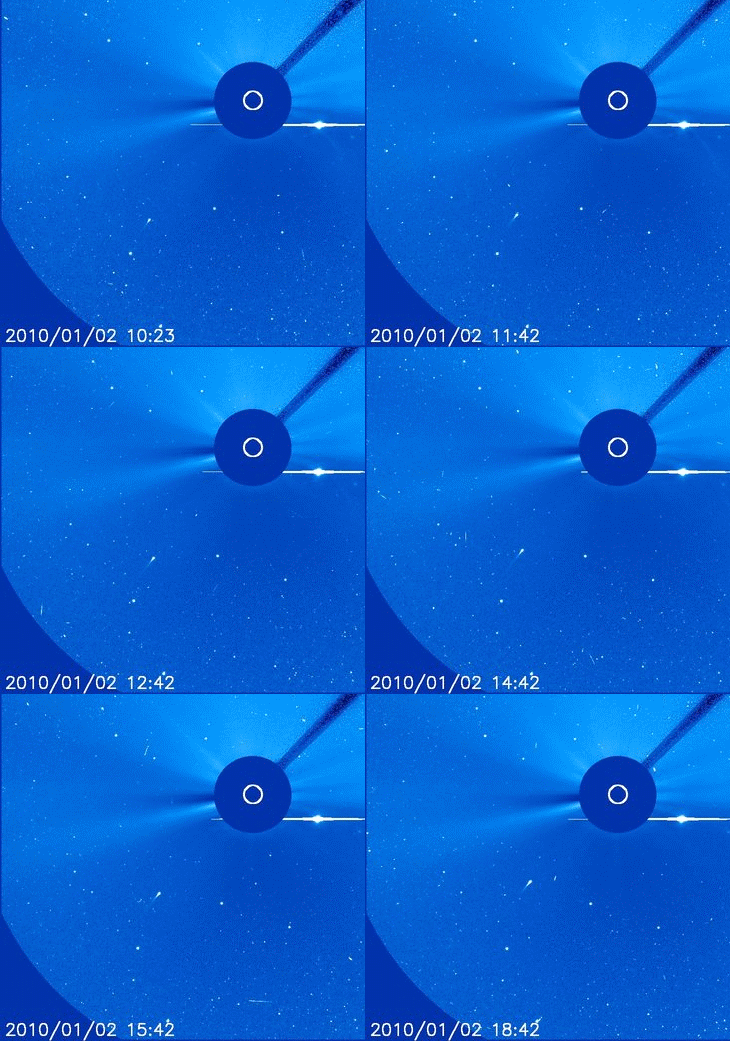
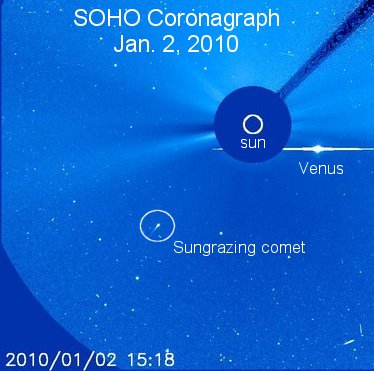
SUNGRAZING COMET ALERT: The Solar and Heliospheric Observatory (SOHO) is tracking a comet that is about to make a perilous close approach to the sun: movie, labels. Will the icy visitor survive? Click here for the latest image. (Note: The comet was discovered by Australian amateur astronomer Alan Watson in images taken by NASA's STEREO-A spacecraft.)
http://www.youtube.com/watch?v=RCi5enrAo_E
Wednesday, October 21, 2009
DailyGalaxy.com | Image of the Day: The Awesome Core of Halley's Comet
The European Space Agency's Giotto spacecraft captured this dramatic image of the nucleus of Halley's Comet when the craft flew by the famous wanderer in 1986. Debris from the comet is the source of tonight's Orionid meteor shower. Halley's Comet returns to the inner solar system once every 75 years. It's next appearance comes in 2061.Source: European Space Agency
Saturday, October 3, 2009
SpaceFellowship.com - Picture of the Day | Comet 217P Linear with extended greenish tail and Great Orion Nebula

These colorful panels in the picture of today both feature a familiar astronomical sight: the stellar nursery known as the Great Orion Nebula. They also offer an intriguing and unfamiliar detail of the nebula rich skyscape — a passing comet. Recorded this weekend with a remotely operated telescope in New Mexico, the right hand image was taken on September 26 and the left on September 27. Comet 217P Linear sports an extended greenish tail and lies above the bluish Running Man reflection nebula near the top of both frames.
Monday, September 21, 2009
Formerly, the Sun was the largest object in the Solar System. Now, comet 17P/Holmes holds that distinction.

The Splintering of Comet 17P/Holmes During a Mega-Outburst
Sunday, September 20, 2009
LifeScience.com | Comet Outburst Spawns Mini-Comets
A comet recently spewed out a cluster of mini comets in a huge outburst that was the largest ever witnessed by astronomers.
A team of researchers began observing the comet 17P/Holmes in October 2007, after it was reported that the object, about 2.2 miles wide (3.6 km wide), had brightened by a million times in less than a day.
READ MORE>>>>>
RELATED
Incredible Comet Bigger than the Sun
By Robert Roy Britt
Senior Science Writer
posted: 15 November 2007
A comet that has delighted backyard astronomers in recent weeks after an unexpected eruption has now grown larger than the sun.
The sun remains by far the most massive object in the solar system, with an extended influence of particles that reaches all the planets. But the comparatively tiny Comet Holmes has released so much gas and dust that its extended atmosphere, or coma, is larger than the diameter of the sun. The comparison is clear in a new image.
"It continues to expand and is now the largest single object in the solar system," according to astronomers at the University of Hawaii.
The coma's diameter on Nov. 9 was 869,900 miles (1.4 million kilometers), based on measurements by Rachel Stevenson, Jan Kleyna and Pedro Lacerda of the University of Hawaii Institute for Astronomy. They used observations from the Canada-France-Hawaii Telescope. The sun's diameter, stated differently by various sources and usually rounded to the nearest 100, is about 864,900 miles (1.392 million kilometers).
Separately, a new Hubble Space Telescope photo of the comet reveals an intriguing bow-tie structure around its nucleus.
The comet's coma—mostly microscopic particles—shines by reflecting sunlight.