
Showing posts with label Solar Flares. Show all posts
Showing posts with label Solar Flares. Show all posts
Tuesday, October 4, 2011
Thursday, September 22, 2011
SolarHam | Top 10 Solar Flares of Cycle 24
Large New Sunspot 1302 (Thurssday) - SDO

Solar Update: Solar activity has been high with one X-Class flare and multiple M-Class flares taking place around the new Sunspot rotating into view on the eastern limb. This region is not yet in prime position for earth directed CMEs. There will remain the chance for strong solar flares.
Top 10 Solar Flares of Cycle 24: (Sunspot number in brackets)
X6.9 - Aug 9, 2011 (1263)
X2.2 - Feb 15, 2011 (1158)
X2.1 - Sept 6, 2011 (1283)
X1.8 - Sept 7, 2011 (1283)
X1.5 - March 9 , 2011 (1166)
X1.4 - Sept 22, 2011 (1302)
M9.3 - Aug 4, 2011 (1261)
M9.3 - July 30, 2011 (1260)
M8.3 - Feb 6, 2010 (1045)
M6.6 - Feb 13, 2011 (1158)
6 of the 10 flares in the past 2 months.


Tuesday, September 13, 2011
Solar flare could unleash nuclear holocaust across planet Earth, forcing hundreds of nuclear power plants into total meltdowns
 http://www.naturalnews.com/033564_solar_flares_nuclear_power_plants.html
NaturalNews) Forget about the 2012 Mayan calendar, comet Elenin or the Rapture. The real threat to human civilization is far more mundane, and it's right in front of our noses. If Fukushima has taught us anything, it's that just one runaway meltdown of fissionable nuclear material can have wide-ranging and potentially devastating consequences for life on Earth. To date, Fukushima has already released 168 times the total radiation released from the Hiroshima nuclear bomb detonated in 1945, and the Fukushima catastrophe is now undeniably the worst nuclear disaster in the history of human civilization.
But what if human civilization faced a far greater threat than a single tsunami destroying a nuclear power facility? What if a global tidal wave could destroy the power generating capacities of all the world's power plants, all at once?
Such a scenario is not merely possible, but factually inevitable. And the global tidal wave threatening all the nuclear power plants of the world isn't made of water but solar emissions.
Friday, September 9, 2011
SDO | Strength and longevity of solar flares could have future implications for communication and navigational satellites

NASA’s Solar Dynamics Observatory (SDO) revealed new information on Wednesday about solar flares indicating an increase in strength and longevity, which could have future implications for the operations of Earth-orbiting communication and navigation satellites. Read more ...
http://www.irishweatheronline.com/news/space/solar/nasa-reveals-new-information-on-solar-flares/36676.html
Friday, August 26, 2011
SolarCycle24.com | Update - August 26, 2011 at 12:20 PM CDT

Solar Update: Several Sunspots located in the nothern hemisphere were numbered on Thursday including 1277, 1278 and 1279. Each of these regions are magnetically simple and do not currently pose a threat for strong solar flares.
Sunspot 1271 which is heading towards the western limb, remains quiet but may still produce C-Class flares.
It appears that the region 1276 is growing again.
Thursday, August 25, 2011
SOLAR UPDATE - THURSDAY AUGUST 27, 2011 AT 11:07 AM CDT

A pair of sunspots have emerged on the north east limb. One of them I thought would have received the number 1277 as it was clearly visible all day long Wednesday, but it did not as of yet. These regions appear to be quiet thus far.
Existing Sunspot 1271 which continues to transit the northern hemisphere, remains a fairly large group and may still produce C-Class flares. NOAA lists a 10% chance for an M-Class event.
http://www.solarham.com/

Wednesday, August 24, 2011

Sunday, August 14, 2011
SOLAR UPDATE - AUGUST 14, 2011 AT 9:28 PM CDT

Eastern Limb: The sun was briefly void of Sunspots on the earth facing side, however a returning sunspot region (1257) is now rotating into view on the northeastern limb. The Solar X-Rays are also increasing and there may soon be a chance for atleast C-Class flares.
Eastern Limb (Sunday) - SXI
Monday, June 20, 2011
SolarCycle24.com | SOLAR Update for June 20, 2011

Solar Update - A small CME took place on Sunday and was caused by a C-Class flare centered around Region 1237. A very small portion of the expanding cloud may be earth directed. I do not expect much in the way geomagnetic storming.
Sunspot 1234 continues to rotate onto the western limb and 1236 produces the odd C-Class flare as it transits the northern hemisphere. A new sunspot is forming just to the east of 1236 on Monday.
Sunday, May 9, 2010
SpaceWeather.com | Solar Flare (C2.4) 5-8-10
AMAZING ERUPTIONS: Departing sunspot 1069 is crackling with solar flares, erupting more than half a dozen times on May 8th alone. NASA's Solar Dynamics Observatory (SDO) video-recorded each of the explosions with a clarity ten times better than HDTV.
Movies: 1.8 MB mpg (web), 0.7 MB m4v (iPad), 0.3 MB m4v (iPhone)
Movies: 1.8 MB mpg (web), 0.7 MB m4v (iPad), 0.3 MB m4v (iPhone)
On the "Richter scale" of solar flares, the eruption you just witnessed registered C2.4. In years past, solar physicists regarded C-flares as minor events, but SDO is revealing them to be quite spectacular. Here are three more examples from May 8th: C1.8-flare, C9-flare, B7-flare.
This amazing footage comes from an observatory that has been in space for only a few months and is still being commissioned. Mission scientists are so busy calibrating sensors, fine-tuning software and generally getting acquainted with their spacecraft, they barely have time to interpret the torrent of data SDO is sending them. This will change in the weeks ahead as the commissioning phase winds down and the discovery phase revs up. Then the real excitement begins. Stay tuned!
more from the Solar Dynamics Observatory:
- First Light for SDO (Science@NASA)
- Massive Eruption, Scorching Rain on the Sun (Science@NASA)
Wednesday, December 23, 2009
SpaceWeather.com | Yesterday, Dec. 22nd magnetic fields around sunspot 1036 erupted, producing a C7-class solar flare
SOLAR ACTIVITY: Yesterday, Dec. 22nd at approximately 0455 UT, magnetic fields around sunspot 1036 erupted, producing a C7-class solar flare. NASA's STEREO-A spacecraft was almost directly above the sunspot at the time of the blast and recorded this extreme ultraviolet movie:

The shadowy wave racing away from the blast site is a "solar tsunami"--a swell of hot, magnetized plasma about 100,000 km high packing as much energy as a million megatons of TNT. The tsunami petered out before it went more than halfway around the sun, but another manifestation of the blast is still going. The eruption hurled a faint coronal mass ejection (CME) into space and the billion-ton cloud should cross Earth's orbit on or about Dec. 25th. A glancing blow to Earth's magnetic field could spark polar auroras for Christmas.
Sunspots 1036 and 1038 are members of new Solar Cycle 24.

http://www.solarmonitor.org/full_disk.php?date=20091223&type=seit_00171&indexnum=1
Wednesday, December 16, 2009
Solar Eruption Heading To Earth
The solar eruption happened in the early morning hours today around a newly formed group of sunspots, and indications are that it should slam into Earth’s magnetic field around December 18th. It doesn’t look like it was a big eruption on the solar flare ‘richter’ scale – C class - but might still cause some colourful auroras so folks living in high-latitude areas – like Canada should be on alert. At this point experts are waiting for more data to come in from Sun watching satellites about the blast itself to know exactly if it will hit Earth directly or will it be just a glancing blow. Stay tuned for more details in the coming days.
 http://www.thenightskyguy.com/?p=1626
Sunday, November 1, 2009
SpaceWeather.com | Sunspot 1029 produced 10 C-class Solar Flare and billion-ton Coronal Mass Ejection CME billowing past Mercury - November 1, 2009
PARTING SHOT: On its way over the sun's western limb on Oct. 31st, sunspot 1029 unleashed a C-class solar flare and a coronal mass ejection (CME). The Solar and Heliospheric Observatory photographed the billion-ton CME billowing past Mercury:
http://spaceweather.com/images2009/31oct09/cme_c3_big.gif?PHPSESSID=st564agnrc6f8epldb23lf45p3
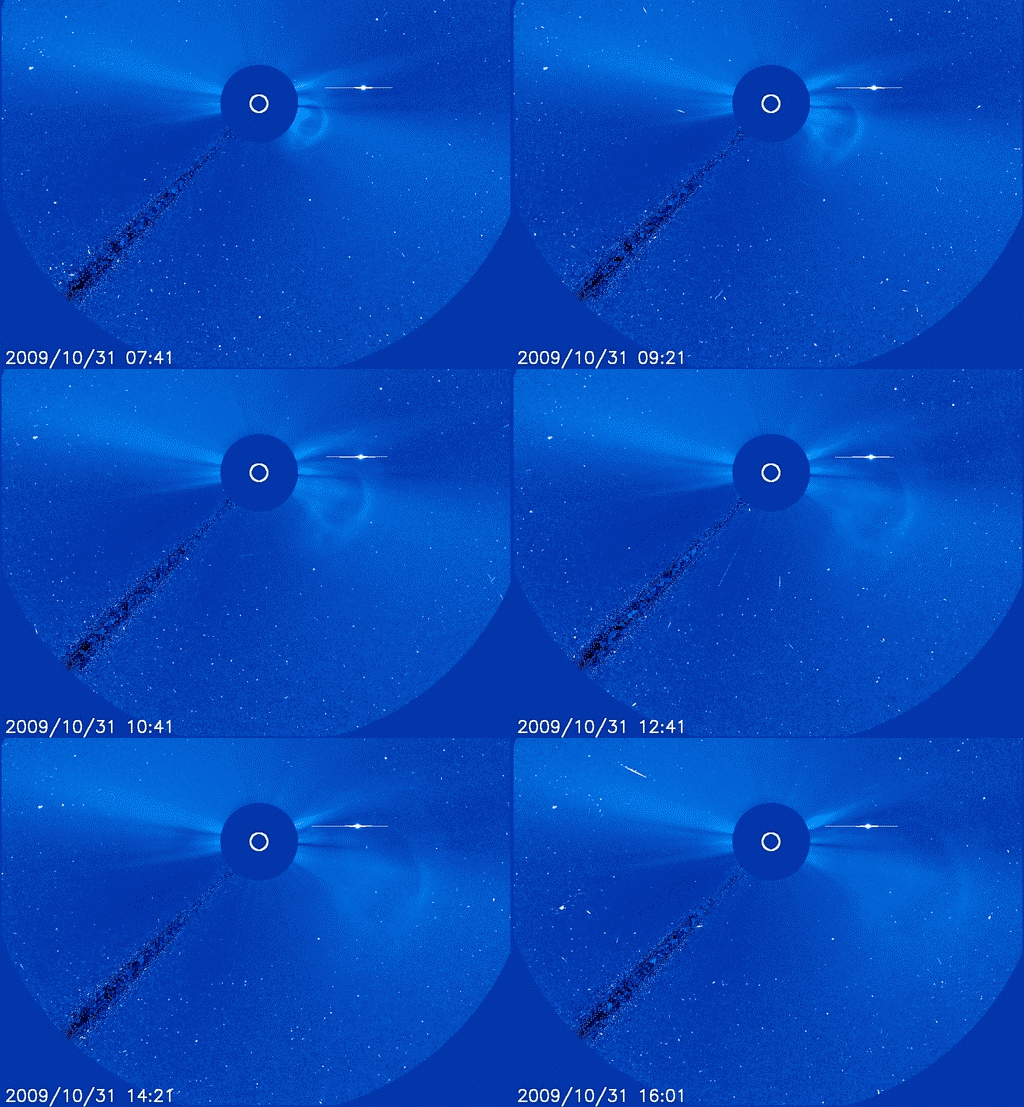
The blast reinforces sunspot's 1029's position as the most active sunspot of 2009. Last week alone, the sunspot produced ten C-class solar flares, more than tripling the number of flares in the previous 10 months. Sunspot 1029 is a member of long-overdue Solar Cycle 24. Is it also a herald of more active times to come? Stay tuned.
Saturday, October 31, 2009
SolarCycle24.com | C1.0 solar flare took place this Saturday morning around 09:30 UTC. This will probably be Sunspot 1029's last goodbye gift.

C1.0 flare captured on STEREO Ahead Saturday morning.
Click to view Movie
http://solarcycle24.com/pictures/1029.gif
Tuesday, October 27, 2009
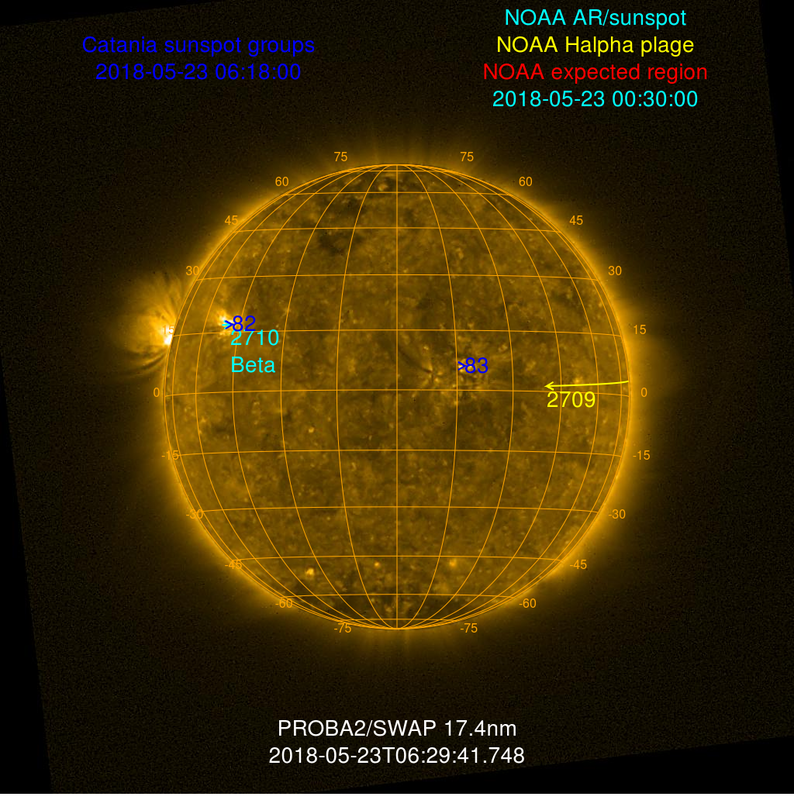
SolarCycle24.com | Sunspot 1029 is a Beta-Gamma sunspot group with potential for C-Class and a lower chance of M-Class solar flares
Several C-Class Flares / Solar Flux above 80
10/27/2009 - Several low level C-Class flares have taken place around Sunspot 1029 in the past 24 hours. There will remain a chance for C-class and perhaps an M-Class flare. Sunspot 1029 has grown in size and is a pretty impressive sunspot cluster for Cycle 24.
The solar flux reached 81.3 on Monday, which is yet again a new record for Cycle 24. This is the highest Flux reading since March 2008 when Cycle 23 sunspots were present on the sun.
10/27/2009 - Several low level C-Class flares have taken place around Sunspot 1029 in the past 24 hours. There will remain a chance for C-class and perhaps an M-Class flare. Sunspot 1029 has grown in size and is a pretty impressive sunspot cluster for Cycle 24.
The solar flux reached 81.3 on Monday, which is yet again a new record for Cycle 24. This is the highest Flux reading since March 2008 when Cycle 23 sunspots were present on the sun.
Monday, October 26, 2009
USAF/NOAA | Sunspot region 1029 producing C1.5 flare continues to decay - with slight chance of M-class Flare - October 26, 2009 7:45am CDT
Prepared jointly by the U.S. Dept. of Commerce, NOAA,
Space Weather Prediction Center and the U.S. Air Force.
Updated 2009 Oct 25 2201 UTC
Space Weather Now

Joint USAF/NOAA Report of Solar and Geophysical Activity
SDF Number 298 Issued at 2200Z on 25 Oct 2009

IA.  Analysis of Solar Active Regions and Activity from  24/2100Z
to 25/2100Z:  Solar activity was low. Region 1029 (N14W12) produced
several B-class events and a C1.5 flare at 25/0226Z. Region 1028
(N24W10) continues to decay.

IB.  Solar Activity Forecast:  Solar activity is expected to be low
with a slight chance of an M-class flare.
RELATED:
There are three categories of flares, X-class, M-class and C-class. The largest, X-class flares are major events that can trigger planet-wide radio blackouts and long-lasting radiation storms. M-class flares are medium-sized, capable of causing brief radio blackouts that affect Earth's polar regions. Minor radiation storms sometimes follow an M-class flare. Compared to X- and M-class events, C-class flares are small with few noticeable consequences here on Earth.
Sunday, October 25, 2009
SpaceWeather.com | Sunspot 1029 emerged this weekend, and it is crackling with B- and C-class solar flares
GROWING SUNSPOT: The sun is showing signs of life. Sunspot 1029 emerged this weekend, and it is crackling with B- and C-class solar flares. This movie from the Solar and Heliospheric Observatory (SOHO) chronicles the sunspot's rapid development from Oct. 23rd through 25th:

The sunspot's magnetic polarity identifies it as a member of new Solar Cycle 24. If its growth continues apace, sunspot 1029 could soon become the biggest sunspot of 2009. Readers with solar telescopes are encouraged to monitor developments.
sunspot images: from Mike Borman of Evansville, Indiana; from Emiel Veldhuis of Zwolle, the Netherlands; from Vahan Yeterian of Lompoc California; from Fabio Acquarone of Genova, Liguria, Italy; from Jan Timmermans of Valkenswaard, The Netherlands; from Paul Haese of Blackwood, South Australia; from Richard Best of Lewes, East Sussex. UK; from Bruno Nolf of Otegem, Belgium


Monday, September 28, 2009
SolarCycle24.com | Sunspot 1027 expanding and consisting of at least 4 sunspots & chance for B-class Flares
Active Regions

Sunspot 1027 expanded in area throughout the day on Monday and consists of at least 4 sunspots. There will be a chance for B-Class flares. Sunspot 1026 was trying to make a comeback today as well, but is currently spotless.
Sunday, September 20, 2009
SolarCycle24. com | Possible B-Class flare activity may now be possible as the X-Ray flux background levels have started to increase
Solar activity may rise within the next 48 hours as the possible sunspot hiding on the eastern limb will soon rotate into view. It has been visible for about a week now in STEREO Behind images. Possible B-Class flare activity may now be possible as the X-Ray flux background levels have started to increase. Farside flare animation from this past week is below.

RELATED:
SpaceWeather.com | The Classification of X-ray Solar Flares
Farside Flare activity
RELATED:
SpaceWeather.com | The Classification of X-ray Solar Flares
Subscribe to:
Posts (Atom)