New research suggests that there may be enough oxygen on Europa to support complex, animal-like organisms....

Showing posts with label Jupiter. Show all posts
Showing posts with label Jupiter. Show all posts
Sunday, October 18, 2009
Thursday, August 27, 2009
Thursday, August 20, 2009
Friday, July 31, 2009
SpaceWeather.com | On July 30, it is evident that there is rapid evolution of Jupiter's impact debris cloud
CHANGES ON JUPITER: "On July 30, it is evident that there is rapid evolution of Jupiter's impact debris cloud," reports amateur astronomer Raffaello Lena of Rome, Italy. "It is becoming very elongated." A polar projection shows the extent of the debris:

The changes are caused by turbulence and especially high-altitude winds in Jupiter's atmosphere. Polar winds blowing 25 m/s and faster could stretch the cloud all the way around Jupiter's south pole in the weeks ahead. Whether such a stretched-out cloud will be visible in small telescopes remains to be seen.
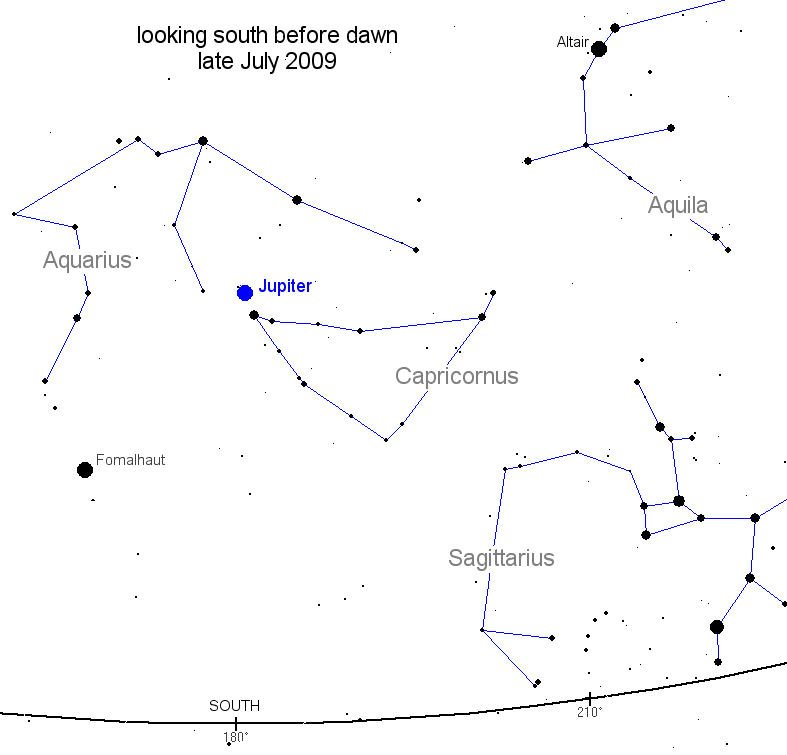
Amateur astronomers are encouraged to continue monitoring. The cloud is located near Jupiter's System II longitude 210°. For the predicted times when it will cross the planet's central meridian, add 2 hours and 6 minutes to Sky and Telescope's predicted transit times for Jupiter's Great Red Spot. [sky map]
more images: from Giovanni Coltro of Pesaro, Italy; from Romulo Liporaci of Maracaibo, Venezuela; from Sid Leach of Scottsdale, Arizona; from Tamas Ladanyi of Bakonykoppany, Hungary; from Efrain Morales Rivera of Aguadilla, Puerto Rico; from Andreas Murner of Lake Chiemsee, Bavaria, Germany; from John Chumack of Dayton, Ohio USA


Thursday, July 30, 2009
Wednesday, July 29, 2009
Dark impact mark on Jupiter now growing larger - also "developing two lobes"
JUPITER UPDATE: Something interesting is happening to the dark impact mark on Jupiter. Not only is it growing larger, but also "it seems to be developing two lobes," says amateur astronomer Mike Hood, who sends this July 28th picture from Kathleen, Georgia:

The same result has been obtained by astrophotographer Raffaello Lena of Rome, Italy. "On July 27th, the Jupiter impact site has evolved and now contained two condensed nucleii," he says.

These changes are surely caused by dynamics in Jupiter's upper atmosphere. High-resolution images from the Hubble Space Telescope show that the impact cloud is being molded by high-altitude winds and turbulence. On a planet where vortices are ubiquitous, perhaps it is no surprise that a cloud would organize itself into two or more swirling spots.
Amateur astronomers are encouraged to continue their monitoring: sky map. The cloud is located near Jupiter's System II longitude 210°. For the predicted times when it will cross the planet's central meridian, add 2 hours and 6 minutes to Sky and Telescope's predicted transit times for Jupiter's Great Red Spot.
Monday, July 20, 2009
SpaceWeather.com | Did something just hit Jupiter? On July 19th, a black "scar" appeared in Jupiter's clouds
POSSIBLE IMPACT EVENT ON JUPITER: Did something just hit Jupiter? On July 19th, a black "scar" appeared in Jupiter's clouds similar to the Shoemaker-Levy 9 impacts of 1994. Veteran Jupiter observer Anthony Wesley photographed the feature from his observatory in Murrumbateman, Australia:

"The jet-black mark is near Jupiter's south pole (south is up in the image)," says Wesley. "I have imagery of that same location from two nights earlier without the impact mark, so this is a very recent event. The material has already begun to spread out in a fan shape on one side, and should be rapidly pulled apart by the fast jetstream winds. I recorded a lot of footage, and will be generating more images and a rotation animation soon."

Amateur astronomers around the world should train their telescopes on Jupiter tonight to monitor the progress of this possible impact event: sky map. Stay tuned for more images and updates.

Thursday, June 18, 2009
SpaceWeather.com | Astronomers are monitoring a new red spot forming in Jupiter's northern hemisphere
GREAT RED SPOT RIVAL: Astronomers are monitoring a new red spot forming in Jupiter's northern hemisphere--a brick-red storm nearly as large as the Great Red Spot itself. On June 17th, amateur astronomer Christopher Go of the Philippines photographed it using an 11-inch Celestron telescope:

"I have been monitoring the new spot since mid-April," says Go. "At first it was relatively small. In late May it began to grow rapidly, and just last week John Rogers of the British Astronomical Association issued an alert for everyone to observe it."
"I hope to get an 890 nanometer 'methane band' image of this object in a few days," adds Go. "A good methane image will prove whether or not the new spot is a genuine anticyclonic storm."
Stay tuned!
EXTRA: Jupiter's atmosphere is rich in methane (CH4), a molecule which absorbs 890 nm light. Viewed through an 890 nm filter, anticyclonic storms such as the Great Red Spot rise above the absorbing methane layer and appear bright. That is why a methane band image will reveal the nature of the new spot.
Subscribe to:
Posts (Atom)