
Tuesday, September 1, 2009
Breaking News and Commentary from Citizens For Legitimate Government | 01 Sep 2009
Breaking: Controversial Blackwater Security Firm Gets Iraq Contract Extended by State Dept --Company Banned From Operating by Iraqi Government Earlier This Year 01 Sep 2009 The State Department has extended a contract with controversial private security firm Blackwater, ABC News has learned. The contract was due to expire this month. Sources say the department has agreed to temporarily continue using the subsidiary known as Presidential Airways to provide helicopter transport for embassy employees around Iraq until a new contract with another security company, DynCorp International, is fully implemented. Presidential Airways is an arm of U.S. Training Center, which is a subsidiary of the company Xe, formerly and still commonly known as Blackwater. [OH GREAT. The child rapists of DynCorp are going to 'eventually' replace the murderers, rapists, sociopaths, arsonists, bombers, thieves and all-around-Blackwater/Xe terrorists. See: DynCorp Disgrace By Kelly Patricia O'Meara 14 Jan 2002 Middle-aged men having sex with 12- to 15-year-olds was too much for Ben Johnston, a hulking 6-foot-5-inch Texan, and more than a year ago he blew the whistle on his employer, DynCorp, a U.S. contracting company doing business in Bosnia.]
Phrase 'War on Terror' Returns to White House Lexicon [It - like Bush himself - never really left.] 01 Sep 2009 Press Secretary Robert Gibbs may have returned the United States to the "War on Terror" -- or at least returned the term "War on Terror" to the White House glossary -- when he used the abandoned phrase Monday in response to a question about the current situation in Afghanistan. "You can't under-resource the most important part of our War on Terror, you can't under-resource that for five or six or seven years... and hope to snap your fingers and have that turn around in just a few months," Gibbs said during the daily briefing to reporters.
CIA: No more interrogation secrets to be disclosed 01 Sep 2009 The CIA says it cannot turn over more details of its interrogations of terror suspects without spilling classified government secrets. A long-secret report released last week shed new light on alleged CIA [torture and] abuses. The spy agency faced a Monday court deadline to turn over more papers, but the agency responded by telling the federal judge in the case that dozens of remaining documents must stay secret.
Doctors' role in CIA abuse 'approaches unlawful human experimentation' - rights group --Doctors had 'central role' in CIA abuse 31 Aug 2009 A US-based medical rights advocacy group on Monday blasted health experts for playing a "central role" in advising and implementing the CIA's abusive interrogation techniques used on terrorism suspects. Physicians for Human Rights (PHR) issued its six-page white paper after shocking details about the range of techniques used by interrogators, including waterboarding, came to light one week ago with release of a 2004 CIA inspector general's report. "Health professionals played a central role in developing, implementing and providing justification for torture," PHR said in its report... PHR warned that such spy agency techniques -- and monitoring by doctors to gauge their effectiveness -- "approaches unlawful experimentation" on human subjects. The report's lead author, PHR medical advisor Scott Allen, said in a statement on the organization's website, "medical doctors and psychologists colluded with the CIA to keep observational records about waterboarding, which approaches unethical and unlawful human experimentation."
CIA's black sites, illuminated --The facilities were never meant to be 'ordinary prisons,' recently released documents reveal in meticulous detail. 31 Aug 2009 Their transformations took place in a sensory cocoon: aboard a CIA aircraft, shackled in place, deprived of sight and sound by blindfolds, headsets and hoods. They emerged into an existence that was hidden for most of the last eight years, but now is possible to glimpse through dozens of declassified files released by the Obama administration last week... They were stripped, shaved and shoved against walls the moment they arrived. What came next was an escalating menu of interrogation options, culminating in a method used in the Inquisition -- waterboarding -- to make them think they would drown.
US judge says Kuwaiti's detention in Guantanamo justified 01 Sep 2009 A US federal judge has ruled the detention of Kuwaiti Fawzi al-Odah justified, saying it was more likely than not he had been a member of the Taliban, in a ruling AFP obtained Tuesday. Now 32, Odah was one of the first Guantanamo detainees prisoners who brought a case to US civilian courts to challenge former US president [sic] George W. Bush's right to detain them indefinitely without charge.
Federal judge denies Al Odah Guantanamo habeas petition 01 Sep 2009 Judge Colleen Kollar-Kotelly of the US District Court for the District of Columbia denied the habeas corpus petition of Guantanamo Bay detainee Fawzi Khalid Abdullah Fahad Al Odah in a partially redacted opinion made public Monday. Kollar-Kelly denied Al Odah's habeas petition last week, finding that the government had shown that it was more likely than not that he "became part of Taliban and al Qaeda forces" after traveling to Afghanistan and attending a terrorist training camp.
August death toll in Iraq is the highest in more than a year 02 Sep 2009 Insurgent attacks produced the highest monthly death toll among Iraqis in 13 months, according to Iraqi government figures obtained by The Times on Tuesday, with August marred by suicide bombings in the north and a high-profile assault on government ministries in Baghdad. A total of 456 Iraqi civilians and security personnel were killed in attacks in August, the Iraqi government figures show. It was the deadliest month since July 2008, when 465 Iraqis died violently...
US Proposes Sending Troops to Disputed Area of Northern Iraq 01 Sep 2009 Recently, the top U.S. military commander in Iraq [General Ray Odierno] said he wants to send American troops to a disputed strip of territory in northern Iraq - for a limited time - to defuse growing tensions between Iraqi security forces and the Kurdish militia. [Yeah, that will help.] The disputed area includes Ninevah Province, which has experienced a string of bloody bombings recently, including in Mosul, one of Iraq's largest cities.
August deadliest month for foreign troops in Afghanistan 02 Sep 2009 Foreign troops fighting in Afghanistan endured their deadliest month since the 2001 invasion in August when 77 soldiers died, an independent website tracking military casualties said Tuesday. Icasualties.org said the 77 deaths came after the 76 who perished in July, which was previously the bloodiest month for foreign troops in Afghanistan.
Bomb kills US service member in Afghanistan 01 Sep 2009 NATO says a U.S. service member has died in Afghanistan from wounds suffered in an explosion. The service member died Tuesday after a bomb attack in southern Afghanistan on Monday.
U.S. Embassy Guards Accused of Misconduct in Afghanistan 01 Sep 2009 Private security contractors Mercenaries who guard the U.S. embassy in Kabul have engaged in lewd behavior and hazed subordinates, demoralizing the undermanned force and posing a "significant threat" to security at time when the Taliban is intensifying attacks in the Afghan capital, according to an investigation released Tuesday by a government watchdog group. The Project on Government Oversight launched the probe after more than a dozen security guards contacted the group to report misconduct and morale problems within the force of 450 guards that lives at Camp Sullivan, a few miles from the U.S. embassy compound.
Animal House in Afghanistan By Daniel Schulman 01 Sep 2009 Drunken brawls, prostitutes, hazing and humiliation, taking vodka shots out of buttcracks-- no, the perpetrators of these Animal House-like antics aren't some depraved frat brothers. They are the private security contractors guarding Camp Sullivan, otherwise known as the US Embassy in Kabul. These allegations, and many more, are contained in a letter sent to Secretary of State Hillary Clinton on Tuesday by the Project on Government Oversight, which has been investigating the embassy security contract held by ArmorGroup North America (a subsidiary of Wackenhut, which is in turn owned by the security behemoth G4S)... Nevertheless, the government opted to extend the company's 5-year, $189 million contract for another year.
Flu fascism alert: Minnesota: Post police car outside infected person's home 01 Sep 2009 As state epidemiologist [Minnesota Department of Health], Dr. Ruth Lynfield's job is to reveal the possibilities for the next wave of swine flu, including the worst-case scenario. For months, Lynfield has been tracking the swine flu outbreak in Minnesota and refining contingency plans... What about an infected person -- could the state force him to stay home? "If they're quarantined, yes," Lynfield tells colleagues at one planning session. "That's the point of quarantine." What if the patient doesn't cooperate? Well, she replies, they could post a police car outside his home.
Iowa officials say no quarantine for swine flu 31 Aug 2009 Iowa public health officials are trying to alert the public that there is no truth to an Internet rumor that the state has instituted a quarantine for the H1N1 flu is untrue. Polly Carver-Kimm, spokeswoman for the Iowa Department of Public Health, said a reporter from Kentucky called the department Monday, asking about something called the "facility quarantine order." [And, here is the nonexistent document: Iowa Department of Public Health - Center for Acute Disease Epidemiology, 'Local Board of Health Quarantine Isolation Rules:' Facility Quarantine Order. '6. Violations of order. If you fail to comply with this Quarantine Order you may be ordered to be quarantined in a more restrictive facility. In addition, failure to comply with this order is a simple misdemeanor for which you may be arrested, fined, and imprisoned. [This document has been saved on the CLG server.]
IDPH Issues Statement On Internet Quarantine Rumor 31 Aug 2009 The Iowa Department of Public Health issued a statement Monday on an Internet rumor circulating about an H1N1 quarantine document. IDPH officials said it's unknown who accessed a copy of the document [? Um, I did - for one] called Iowa’s "Facility Quarantine Order" that is now being shared on the Internet on some rumor Web sites and by e-mail. Department official said "IDPH wants to make it clear that Iowa has not issued any isolation and quarantine orders for novel influenza A (H1N1), and has no plans to issue any this fall." Officials said it is common for document templates to be prepared in case they are needed, but they said isolation and quarantine orders are "only rarely used in very specific situations." [Yup, it's the classic non-denial denial. IDPH: It's being 'shared on the Internet' because you uploaded it *to* the Internet. --LRP]
'We definitely reserve the right to take a look at someone, we can definitely take them off the plane.' 01 Sep 2009 Airlines say they're preparing for the return of swine flu this fall.. Rather than impose special measures to deal with the H1N1 virus, several U.S. carriers emphasize they'll follow long-standing policies that permit them to keep an ill person from flying, whatever the sickness. "We do definitely reserve that right to take a look at someone, and if they exhibit signs of having a communicable disease and flying is not in their best interest, we can definitely take them off and get them the medical care that they need," says Paul Flaningan, a Southwest spokesman.
'Chicago's schools plan to track real-time attendance for the first time to identify hotspots.' New York, L.A., Boston Set Up Swine Flu Vaccination Centers 01 Sep 2009 New York, Los Angeles and Boston are setting up swine flu centers to administer vaccinations as part of a plan to slow foment the spread of the virus that U.S. health officials have said may infect half the nation’s population. New York will offer free immunizations at elementary schools and distribute the vaccine through about 100 health clinics, according to plans released today by Mayor Michael Bloomberg’s office. Los Angeles will give out shots at its fair grounds, Boston is letting city employees leave work for two hours to get vaccinated and Chicago’s schools plan to track real-time attendance for the first time to identify hotspots, spokesmen for those municipalities said.
Swine flu vaccine trial seeks volunteers 01 Sep 2009 Researchers at Stanford University School of Medicine are looking for healthy adults to test a new swine flu vaccine mixed with an ingredient that could boost people's immune response. Adding such a chemical adjuvant to the vaccine could help stretch limited supplies by making a single dose more potent, researchers believe. [Why don't the pharma-terrorists test it on *themselves?*]
Cheney in 2012? Now there's a real September surprise 01 Sep 2009 James Taranto, a columnist for the Wall Street Journal, is suggesting that [Dick] Cheney would be a terrific presidential candidate in 2012. If national security emerges as the key issue in the election, he argues, "Republicans would be wise to nominate someone with both toughness and experience. Under such circumstances, it’s hard to think of a better candidate -- assuming, of course, that he could be persuaded to run -- than Richard B. Cheney." The calculus: If the Afghanistan war worsens, it will become Obama’s war. And if terrorists attack this country again, a fierce voice on national security might have a chance.
US pastor prays for Obama's death in 'spiritual warfare' 01 Sep 2009 A pastor has caused outrage among church-goers in Phoenix, Arizona after praying for the death of the African-American US President Barack Obama. In his August 16 sermon entitled "Why I Hate Barack Obama," the Phoenix-area pastor, Steven Anderson, asked his parishioners to join him in prayer for Obama's death. "I hope that God strikes Barack Obama with brain cancer so he can die like Ted Kennedy and I hope it happens today," he told 'MyFOXPhoenix,' a local broadcasting affiliate of the right-wing FOXNews network.
'Yet again, the banks are putting profit over people.' RBS Protesters Glue Hands to Trading Floor 01 Sep 2009 Environmental campaigners have glued their hands to the trading floor of RBS in the City of London, Sky sources say. The protesters disguised themselves as construction workers to get into the company's Bishopgate HQ. They unfurled banners which read "RBS: under new ownership" and "Ethical renovation in progress". The activists said they were protesting against the bank's investments in fossil fuel projects, especially funding for the coal industry and tar sands extraction in Canada.
Ban Ki-moon 'alarmed' by melting glaciers on visit to Arctic 01 Sep 2009 The UN Secretary General Ban Ki-moon said on Tuesday he was "alarmed" by the rate at which the Arctic's glaciers were retreating as he visited the region ahead of key climate talks in December. Mr Ban said world leaders had a "moral political responsibility" to safeguard the future of the planet. "I am very much alarmed and surprised to have seen these glaciers all worn," he told journalists as he visited the Ny-Aalesund climate change research station in the Svalbard archipelago, located 745 miles from the North Pole.
Fierce California fires tear into tattered budget 01 Sep 2009 California's wildfires are burning through state cash at an alarming rate, with the government spending more than half its annual firefighting budget just two months into the fiscal year -- even before the traditional fire season began on Tuesday. The state's ballooning budget deficit and sharp drop in revenues resulting from the recession have forced delays in replacing aging firefighting equipment, including 40-year-old bulldozers.
Previous lead stories: Iraq ministry bombers 'recently freed by US' --The suicide bombers who killed 95 people in devastating attacks at Iraqi government ministries on August 19 had recently been released from US custody, a senior interior ministry official said on Sunday. 31 Aug 2009 The bombings in Baghdad also wounded 600 people in what was the worst day of violence to hit the country for 18 months. "The suicide bomber who blew himself up at the ministry of foreign affairs was released three months ago from Camp Bucca," the official told AFP on condition of anonymity, referring to the US jail near Basra. "The suicide bomber who blew himself up outside the ministry of finance was also released a few months ago from the same jail."
US Hummers Enter Pakistan, Undercover American Soldiers In Islamabad By Ahmed Quraishi 01 Sep 2009 Undercover armed Americans are swarming the Pakistani capital in the latest sign that the elected government has allowed Washington to dispatch what is believed to be a large number of American special operations agents and contractual security guards, including the infamous Blackwater private militia... The latest evidence of the growing American military presence in the Pakistani capital is the arrest of four Americans carrying automatic weapons in a part of the Pakistani capital that foreigners seldom visit. The four were arrested in Sector G-9 of Islamabad in the evening of Saturday, Aug. 29.


Cave Headline - September 1, 2009
 Treasury.gov Recent News
U.S. International Reserve Position
PRELIMINARY ANNUAL REPORT ON U.S. HOLDING OF FOREIGN SECURITIES
Financial Sector Self-Assessment Reviews Issued to IMF
Treasury Department Public Engagements Schedule
Treasury Department Statement Marking the Beginning of Ramadan
Treasury Announces $309 Million in Recovery Act Funds
U.S. International Reserve Position
View more >>
TheWashingtonNote.com | Guest Post by Jim Krane: Dubai, Not Obama, is the Mideast's Best Peace Hope
Tuesday, Sep 01 2009, 3:11PM
This is a guest note by Jim Krane, a former AP Persian Gulf correspondent. His new book on Dubai, City of Gold: Dubai and the Dream of Capitalism, is available here.
As Americans, Israelis and Palestinians continue their endless peace-jockeying, a more hopeful solution has emerged. It is a fresh Arab initiative that depends neither on America nor Israel.
It is Dubai.
Dubai, you must know, is the flashy Gulf city-state that is one of the seven United Arab Emirates. In my book, I argue that Dubaians, descended from illiterate Bedouin who faced starvation in the 1940s, have authored the most exciting Arab accomplishment in 700 years.
JSMineset.com | China tells the Wall Street OTC derivative manufacturers and distributors to go straight to h...
My Dear Friends,
China tells the Wall Street OTC derivative manufacturers and distributors to go straight to hell.
China has invoked a "Stop Loss" on these fraud ridden instruments.
Archive September 1, 2009 - Clif High (HalfPastHuman.com) Web Bot Interview with Michael St. Clair:
1. http://api.ning.com/files/OuVAWy1SY-kUP-IrZ5n-UaJl5Wwe0upIf-ZLWMAAIzdQmqfs3HoyDlddvMbTKiF3IkC2bz6s1Xv2CJlUtb04j5kiuK5I74Qw/NibelungentalkwithClifHighpart1.mp3
2. http://api.ning.com/files/OuVAWy1SY-lCR5YnUi228Yzcc-3-kV6lrdlIUO0z9BRCANQp474w5hnf6gEDjwQ8DG1eSAMNFm*-TBfbQ9hDwHEIUtGjGMkm/NibelungentalkwithClifHighpart2.mp3
Peter Schiff on King World News August 28 2009 (YouTube)
PETER SCHIFF 2 OF 3 ON KING WORLD NEWS AUGUST 28, 2009
http://www.youtube.com/watch?v=JFfxO...eature=related
PETER SCHIFF 3 OF 3 ON KING WORLD NEWS AUGUST 28, 2009
http://www.youtube.com/watch?v=bASWJ...eature=related
EarthObservatory | Latest Images - September 1, 2009
------------------------------------------------------------------------
* World of Change: Severe Storms
http://earthobservatory.nasa.gov/Features/WorldOfChange/storms.php?src=eoa-features
* Oil Slick in the Timor Sea
http://earthobservatory.nasa.gov/IOTD/view.php?id=40029&src=eoa-iotd
* Fires in Los Angeles County
http://earthobservatory.nasa.gov/IOTD/view.php?id=40011&src=eoa-iotd
* Heiltskuk Icefield, British Columbia
http://earthobservatory.nasa.gov/IOTD/view.php?id=39985&src=eoa-iotd
* Blackwater National Wildlife Refuge
http://earthobservatory.nasa.gov/IOTD/view.php?id=39988&src=eoa-iotd
* Burn Scar Near Athens, Greece
http://earthobservatory.nasa.gov/IOTD/view.php?id=39991&src=eoa-iotd
* Strongest Storms Each Year This Decade: 2008, Super Typhoon Jangmi
http://earthobservatory.nasa.gov/IOTD/view.php?id=39981&src=eoa-iotd
* Aral Sea Continues to Shrink, August 2009
http://earthobservatory.nasa.gov/IOTD/view.php?id=39944&src=eoa-iotd
* Afternoon Clouds over the Amazon Rainforest
http://earthobservatory.nasa.gov/IOTD/view.php?id=39936&src=eoa-iotd
--------------------
NASA News:
* Map Characterizes Active Lakes Below Antarctic Ice
http://earthobservatory.nasa.gov/Newsroom/view.php?id=40040&src=eoa-nnews
* From the Moon to Marine Measurements
http://earthobservatory.nasa.gov/Newsroom/view.php?id=40041&src=eoa-nnews
* What's Holding Antarctic Sea Ice Back From Melting?
http://earthobservatory.nasa.gov/Newsroom/view.php?id=40042&src=eoa-nnews
* Satellites and Submarines Give the Skinny on Sea Ice Thickness
http://earthobservatory.nasa.gov/Newsroom/view.php?id=40043&src=eoa-nnews
--------------------
Headlines from the press, radio, and television:
* Upwards Lightning Caught on Film
http://earthobservatory.nasa.gov/Newsroom/view.php?id=39971&src=eoa-hnews
* Australians 'Need More Seasons'
http://earthobservatory.nasa.gov/Newsroom/view.php?id=39972&src=eoa-hnews
* Ink Found in Jurassic-Era Squid
http://earthobservatory.nasa.gov/Newsroom/view.php?id=39973&src=eoa-hnews
* Warming Oceans May Shift Earth's Pole
http://earthobservatory.nasa.gov/Newsroom/view.php?id=39974&src=eoa-hnews
* World's Oceans Set Temperature Record
http://earthobservatory.nasa.gov/Newsroom/view.php?id=39975&src=eoa-hnews
* Slide Show: Coastlines under Threat
http://earthobservatory.nasa.gov/Newsroom/view.php?id=39976&src=eoa-hnews
* Plastics Decompose in Ocean
http://earthobservatory.nasa.gov/Newsroom/view.php?id=39977&src=eoa-hnews
* Climate Change Means More Heavy Rain
http://earthobservatory.nasa.gov/Newsroom/view.php?id=39978&src=eoa-hnews
--------------------
New Research Highlights
http://earthobservatory.nasa.gov/Newsroom/archive.php?cat_id=19&src=eoa
--------------------
Press releases from institutions that either address climate research or are NASA-funded.
* Plastics in Oceans Decompose, Release Hazardous Chemicals, Surprising New Study Says
http://earthobservatory.nasa.gov/Newsroom/view.php?id=39979&src=eoa-manews
* Lightning's Mirror Image … Only Much Bigger
http://earthobservatory.nasa.gov/Newsroom/view.php?id=39980&src=eoa-manews
--------------------
NaturalNews.com | Today's Featured Stories - September 1, 2009
| Why swine flu vaccines just don't add up: Doing the (fuzzy) math (NaturalNews) Here's a seventh grade word problem for you: If swine flu has infected one million people and killed 500, how many people might be expected to die if it infects 150 million people (assuming no major changes in the virus)? The correct answer... |
| Long or Short Term Use: All Hormone Replacement Therapy Raises Ovarian Cancer Risk (NaturalNews) Cancer of the ovary is rarely found early and, by the time it is discovered, the disease has frequently spread. So prevention is the most important way to fight this frequently deadly malignancy. Unfortunately, new research shows a medical... |
| Study Proves Link Between Thimerosal and Autism Neurotoxicity In a study just published, a causal connection between Thimerosal, the preservative often used in vaccines, and the brain pathology found in patients diagnosed with autism spectrum disorder (ASD), has been established. The study, A Mitochondrial... |
| Inhalation of Silver Nanoparticles Results in "Miraculous" Protection Against Pneumonia (NaturalNews) Silver-based nanoparticles may prove the most effective method yet of delivering pneumonia medications, according to a study conducted by researchers from the Washington University School of Medicine and the University of Akron, Ohio, and... |
| A War is against Your Immune System, Part I Is it a stretch to speculate that the coming swine flu vaccinations will be the actual trigger for the mother of all flu pandemics? Could we have a chain reaction that would be falsely attributed as part of the swine flu pandemic, justifying... |
| Olive Leaf Offers Many Healing Benefits The healing benefits of olive leaf has been used for thousands of years and originated in Ancient Egypt. The olive leaf was used by many as a sign of heavenly power. In the 1850`s, there is documentation showing how olive leaf cured malaria... |
| Cherie Soria Part I: From Cooking Contest to Raw Food Lifestyle This interview is an excerpt from Kevin Gianni's Rawkathon, which can be found at http://www.Rawkathon.com. In this excerpt, Cherie Soria shares on going from winning a cooking contest to embracing a raw food lifestyle. Rawkathon... |
| Aleni Prokopius speaks out on vaccines and a cure for autism in NaturalNews interview (NaturalNews) In a new online interview just posted, Aleni Prokopius from "Green Diva Mom" (www.GreenDivaMom.com) shares her story of vaccines causing autism in her son. As a healthy new mom, Aleni thought the health of her newborn son would be well protected... |
EarthObservatory | Fires in Los Angeles County
 On the evening of August 31, 2009, the Incident Information System, estimated the size of the Station Fire, north of the city of Los Angeles, at 105,296 acres. The Los Angeles Times reported that the fire had burned 74 structures and remained out of control, spreading both west and north. As of 6:30 p.m. Pacific Daylight Time on August 31, some 12,000 homes were threatened. Fire fighters struggled to save the Mt. Wilson Observatory from the encroaching fire.
The Moderate Resolution Imaging Spectroradiometer (MODIS) on NASA’s Aqua satellite captured this true-color image around 2:05 p.m. local time (21:05 UTC) on August 31, 2009. Red outlines indicate high surface temperatures associated with wildfires, and almost reach Mt. Wilson. A long plume of smoke blows away from the fire toward the northeast.
References
- Staff. (2009, August 31). L.A. County fire has destroyed 74 structures, remains out of control. Los Angeles Times. Accessed August 31, 2009.
NASA image by Jeff Schmaltz, MODIS Rapid Response Team, Goddard Space Flight Center. The Rapid Response Team provides daily images of this area. Caption by Michon Scott.
- Instrument:
- Aqua - MODIS
NASA.gov | Map Characterizes Active Lakes Below Antarctic Ice
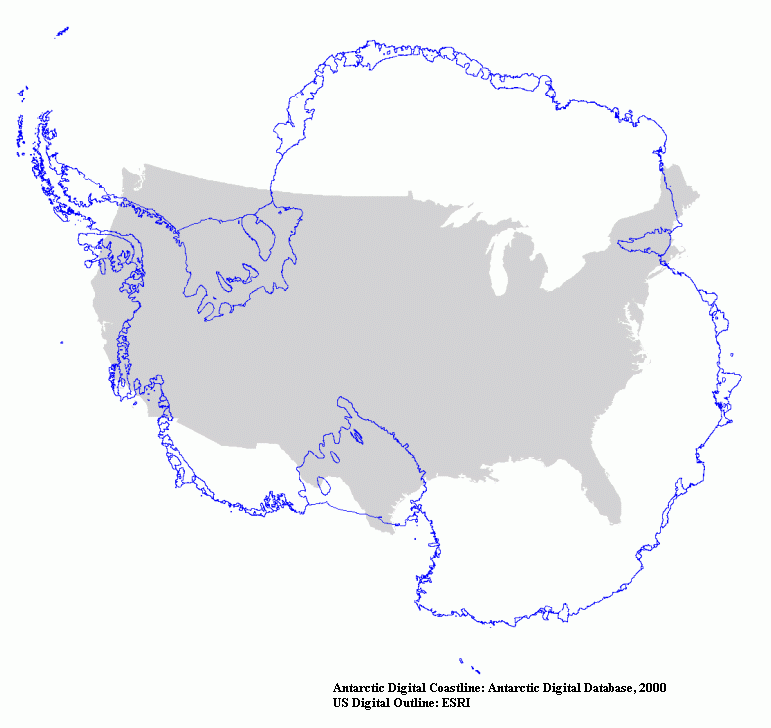
 Dots represent the locations where scientists have identified 124 active lakes below the ice sheet in Antarctica. Warmer colors (orange and red) depict lakes with larger water volumes while cooler colors (green and blue) depict lakes with smaller volumes. Purple areas show the locations of previously known inactive lakes. Credit: Ben Smith, University of Washington
Related:
SteveQuayle.com | Hot Headlines - September 1, 2009
As Hybrid Cars Gobble Rare Metals, Shortage Looms
China Invokes a “Stop Loss” on OTC Derivatives
World's Stocks Controlled by Select Few
Seller, Beware: Feds Cracking Down on Secondhand Sales of Some Products
The Bananas are Back
Mike Whitney: Band-Aids for the Recession
RFID Chip to Detect Swine Flu Virus?
ABC News Exclusive: National Security Adviser Says President Obama Is Having Greater Success Taking Terrorists Out of Commission Than Bush Did
You Won't Believe Who Muslims Promote as 'Antichrist'
Solana: Israel to Agree to Freeze Before UN Meets
Forbidden
Punishing Patriots
Larry Grathwohl on Ayers' Plan for American Re-Education Camps and the Need to Kill Millions – video
Blaze Consumes 105,000 Acres, No End in Sight Japan's Leader Yukio Hatoyama Vows End to ‘Cosy’ Triangle
‘We Hate the United States’: Secessionists Rally in Texas
Glenn Beck: Speak Without Fear & Question Boldly – video
NM Rothschild Pitches Motorway Privatisation Plan
Scientists Design Spacecraft to Save Earth
Omlet.co.uk | Introducing the Eglu Cube - Cool Chicken House!!


SkyMania.com | Solar storm 150 years ago in September 1859 gave the Earth the "mother of all buffetings" -
 Tuesday, September 01, 2009
A spectacular explosion on the Sun that rocked the Earth 150 years ago this week could threaten the lives of tens of millions of people if it happened again today.
The solar storm in September 1859 gave the Earth the mother of all buffetings. A worldwide aurora turned night into day.
Telegraph operators were knocked out or shocked as sparks and flames leapt from their wires in a huge electrical surge.
But in today's technology-dependent world, a similar event could bring down civilization in the biggest disaster ever to hit mankind.
More havoc would be wreaked than in an asteroid impact, say experts. And humans would face doom as power and communications grids around the globe were destroyed by the event, preventing the production and supply of food, water and medicines.
A British amateur astronomer, Richard Carrington, 33, witnessed the start of the storm that battered the Earth 150 years ago. He was sketching a giant blotch on the sun called a sunspot from near Redhill, Surrey, on September 1 when two dazzling beads of light appeared above it. They were the first observed solar flares.
They faded within minutes. But the next eight days the night skies all around the globe were filled with dazzling red, green and purple auroras. They are usually just seen near the poles.
They were caused by a billion tons of highly charged gas, called plasma, that battered the Earth after racing 93 million miles from the Sun at more than five million miles an hour. Smaller eruptions have been photographed by spacecraft such NASA's as Stereo.
Our planet's natural shield, its magnetic field, protected humans from the deadly radiation in 1859 by deflecting it around the magnetic poles. But the massive electrical charge knocked out the Victorian equivalent of the internet, by sending telegraph systems haywire.
Operators shocked by the surge quickly disconnected batteries that powered the telegraph network. But they found it kept working thanks to the power from the aurora.
The next time a perfect solar storm on the same scale is aimed at Earth, the result will be devastating - and much more so for the developed world than for poor countries.
Eight minutes after the flare - called a coronal mass ejection or CME - happens, a pulse of X-rays will cause huge disruption to radio communications. Then, 18 to 36 hours later, we will feel the full impact of space weather with the arrival of superheated gas called plasma from the Sun.
Satellites on which we rely for communications will have their electronics fried, causing £40 billion damage in space. Astronauts on the space station or space tourists will die from massive doses of radiation.
Then power grids around the world will be destroyed as transformers melt, beyond repair. It will take many months or years to replace them. A NASA report says the blackouts would cause more than a trillion pounds worth of damage to the US economy alone.
British scientist Dr Stuart Clark is a solar expert who has written a gripping book about the 1859 solar storm and Richard Carrington called The Sun Kings
 . He told Skymania News: "These ejections from the Sun are huge. They can contain a billion tons of matter - smashed up atoms carrying vast quantities of electrical and magnetic energy - and that's what can do the damage. It will short out satellites vital for communications and GPS, turning them into useless junk.
"The space station does not have sufficient shielding. A Carrington-sized flare would be unsurvivable."
Dr Clark added: "The impact on power grids is the most dangerous effect. Another 1859-sized flare could take out power transformers right across the United States, at which point you have the biggest natural disaster possible. You can't replace these transformers quickly. So you face weeks, months or potentially even years without proper power supplies.
"The ripple effect from that is colossal. Without power you can't pump fuel so you can't drive food to the supermarkets. You can't pump water to homes or handle sewage. With no power, there is no communication, no way for the Government to pass on information or advice. And even if you think about back-up generators, in places like hospitals, the petrol they need is not going to last longer than a couple of days. Millions will die.
"You could see society collapse and a complete breakdown in law and order. Nowhere is safe from a Carrington-sized flare. This is much more threatening than an asteroid impact and it is much more likely than an asteroid."
Dr Clark said that much less powerful space weather had already given an indication of the havoc that would be created. "In 1989 north-eastern Canada was knocked out by a solar storm. The region went from normal operations to a completely melted transformer in 90 seconds, cutting power to six million people. Repairs took months.
"Another series of storms battered the Earth around Halloween in 2003. At least two satellites were wrecked and 60 per cent of NASA satellites malfunctioned in some way.
"During that battering, they moved aircraft away from the magnetic poles. The main reason was to avoid communications blackouts, but they were also concerned about radiation levels in passenger jets."
Scientists have found a tree-ring like record in the Arctic ice of how solar activity has affected Earth. They estimate that a solar event like that of 1859 happens twice in a thousand years. But there is nothing to say it won't happen next week.
And Dr Clark says that a general decline in the sun's level of activity is creating conditions like those around the time that Carrington observed his fantastic flare.
He said: "Hopefully, with space telescopes observing the Sun, it means we won't be taken by surprise and will see a storm coming. But get it wrong and we'll have hardly any time to take action and the damage will be done.
"The individual can literally do nothing to protect himself apart from get in some tins of beans and candles. And the only thing we can do to protect power stations is to turn them off.
"If you see one of these things coming and decide it is big enough, turn the power off. That means people will die, there will be accidents, but it is the only sure fire way to protect the power stations.
"But there is no chain of command, no structure for deciding when to turn the power off. And we have no idea when disaster will strike."
Picture: Dramatic activity on the Sun in September 1999, photographed by the SoHo spacecraft - but on nothing like the scale of 1 September 1859. (Credit: ESA/NASA).
Cave Editor's Note: Do you have your "tins of beans"?? ... and make sure you protect the power stations ... heck with the people! Can't put this article under self-sufficiency...with the advise of a tin of beans and some candles...
Chelsea Clinton's wedding to Goldman Sachs banker Marc Mezvinsky on Chappaquiddick Island while Obamas were vacationing are denied

http://blog.taragana.com/n/chelsea-clintons-nuptials-on-chappaquiddick-island-denied-156233/
September 1, 2009: NEW YORK - Former US First Daughter Chelsea Clinton has been revealed to be nowhere close to tying the knot with her fiance, Marc Mezvinsky, even though rumours have stated otherwise.
When pictures of a big wedding stage being built on Chappaquiddick Island off Martha’s Vineyard emerged, it was automatically assumed that Clinton, 29, would be getting married.
But Clinton’s spokesman Matt McKenna, who’s been denying the purported union for months, said that he’d wager 1,000 dollars it’s not on.
“I know this spot on Chappy very well, and I know the two brides who will get married there this coming weekend (on different days — not to each other),” the New York Post quoted Democrat Serena Torrey Roosevelt as writing on Facebook.
“Neither of them is Chelsea,” she added. (ANI)
RELATED:
http://allthingshillaryclinton.blogspot.com/2009/03/chelsea-tying-knot.html
Tuesday March 31, 2009 - AllThingsHillaryClinton.Blogspot.com: Marc is currently an investment banker at Goldman Sachs.

He just recently recently forked over an impressive $4 million for a 10th floor apartment overlooking the park on lower Fifth Avenue. (note- the furniture in the image is of the seller's not Marc's... I'd imagine his would be much less chic)
May 1, 2009 - BOSTON GLOBE: Buzz is building that Chelsea Clinton will get married on Martha's Vineyard this summer. Sources on the island tell us that the former first daughter will wed Marc Mezvinsky at Ted Danson and Mary Steenburgen's home in Chilmark this August. The wedding coincides with President Barack Obama's rumored vacation on the Vineyard. To prepare for the A-list affair, Danson and Steenburgen are said to be doing extensive renovations on their property. Vineyard caterer Jaime Hamlin, who helped throw one of Bill Clinton's birthday parties on the island, said there's plenty of local excitement about Chelsea's upcoming nuptials, especially among vendors who hope to get some business from the Clintons. "They haven't called me yet," Hamlin joked. "Maybe they will." The young Clinton met Mezvinsky years ago through her parents. He is the son of former Iowa congressman Edward Mezvinsky, and like Chelsea, studied at Stanford University in California.
http://www.huffingtonpost.com/2009/05/01/marc-mezvinsky-chelsea-cl_n_194862.html
The Huffington Post | 05/ 1/09 05:49 PM Mezvinsky is the son of former Iowa congressman Edward Mezvinsky and former Pennsylvania congresswoman Marjorie Margolies-Mezvinsky. Like Clinton, he studied at Stanford University in California. He's also familiar with parental scandal: his father pleaded guilty in 2002 to tricking investors out of over $10 million. Clinton has been dating Mezvinsky, an investment banker with Goldman Sachs, since 2005.
Joyce Riley's THE POWER HOUR NEWS - September 1, 2009
Expect your computer to be seized without suspicion -- The US Dept. of Homeland Security published a paper referring to new guidelines for its immigration and customs agents regarding how they may conduct border searches of travelers’ computers and electronic media.
Leaked French document reveals details of WHO forced vaccination program starting Sept 28 -- EMERGENCY UPDATE: French government document details forced mass vaccination plans from September 28th: GPs and hospitals to be excluded. Similar documents believed to be circulating in all WHO member states.
Schools ban touching to limit spread of H1N1 -- Glen Cove District Students Urged To Have No Skin-On-Skin Contact. With Swine Flu Outbreak Looming Parents Told To Provide Kids With Tissues, Hand Sanitizer, Ibuprofen.
90,000 flu deaths. Where did that number come from? -- The warning is dire: Up to 90,000 "possible" deaths from a potential swine flu outbreak.
But how did the president's science advisers, who came up with the number, reach that estimate?
The Swine Flu Hype Center -- Swine Flu Hype is truly the next round, following the 2006 episode of Bird Flu Hype. This section will document this rapidly unfolding story and give you links to information you may have missed. Scan the articles and sections on the Bird Flu Hype page. History is repeating itself.
Why swine flu vaccines don't add up. Doing the (fuzzy) math -- Here's a seventh grade word problem for you: If swine flu has infected one million people and killed 500, how many people might be expected to die if it infects 150 million people (assuming no major changes in the virus)? The correct answer, of course, is 75,000 people, and that's within the range of the number of swine flu deaths now being publicly predicted by the White House. Read More...
Document: THE INFOWARRIOR MANUAL -- A HOW TO GUIDE FOR FIGHTING AND WINNING THE INFOWAR.
EU starts turning out old fashioned light bulbs -- Tuesday marks the beginning of the end for traditional, energy-guzzling light bulbs throughout Europe, with the 100-watt and frosted bulbs the first to go.
Chemicals leach from packaging -- Plastic, rubber, cardboard, metal, and glass packaging act as a barrier against all sorts of contamination, but they are also a source of contamination. Some components of food packaging end up in your food.
Pittsburg City council mulls assault weapons ban for G-20 summit -- As the G-20 Summit nears, Pittsburgh City Council is considering the possibility of instituting an assault weapons ban during the high-profile event.
Iowa Department of Public Health -- This is the 1st letter that is sent out to those who are a threat to the community who have been exposed to H1N1 in Iowa. This letter explains that you are confined to your home. If you do not stay confirmed to your home, you get the second letter which is located at: http://www2a.cdc.gov/phlp/docs/Facility Quarantine Order novelflu filled in 4-30-09.pdf
Rise of mercenary armies threatens world -- The growing use of private armies not only subjects target populations to savage warfare but makes it easier for the White House to subvert domestic public opinion and wage wars. Americans are less inclined to oppose a war that is being fought by hired foreign mercenaries, even when their own tax dollars are being squandered to fund it.
A primer on martial law -- In sum, “martial law” in the third sense of that term cannot exist in this country. It is a legal impossibility. Participation in it would constitute the most serious of all crimes. And it would supply just grounds for mass resistance among the citizenry aimed at overthrowing whatever purported governmental apparatus attempted to impose it.
The effect of economic recessions on population health -- Studies show that unemployment can be bad for people's health, yet smoking, excessive alcohol consumption and overeating decline during recessions with beneficial impacts on health. Perhaps even more importantly when unemployment rates soar, people have more time for friends and family (especially children) which results in lower mortality.
History of Camp Crane from 1918 flu epidemic-interesting info -- Camp Crane ultimately proved not to be an escape community, and for this reason we chose not to include it in our final report. The experience of the camp during the 1918-1920 influenza epidemic was still rather remarkable, however, given that the camp was located on a very small parcel of land in the middle of busy downtown Allentown, Pennsylvania. We therefore decided to present the research materials here.
Natural compounds & chemotherapeutic drugs may become partners in cancer therapy -- Research in the Linus Pauling Institute at Oregon State University suggests that some natural food compounds, which previously have been studied for their ability to prevent cancer, may be able to play a more significant role in treating it – working side-by-side with the conventional drugs that are now used in chemotherapy.
Military cancels controversial reporter rating contract -- On Monday last week, Stars & Stripes broke the story that U.S. forces in Afghanistan had hired The Rendon Group, a D.C.-based media consulting firm, to write assessments of war reporters. On Sunday, the military canceled Rendon’s contract. “As the senior U.S. communicator in Afghanistan, it was clear that the issue of Rendon’s support to U.S. forces in Afghanistan had become a distraction from our main mission,” Rear Adm. Gregory J. Smith, said in an e-mail to Stars & Stripes.
International Paper treads Monsanto's path to 'Frankenforests", GM trees to be planted all over country -- International Paper Co., the world’s largest pulp and paper maker, plans to remake commercial forests in the same way Monsanto Co. revolutionized farms with genetically modified crops.
'Man in a Van' collecting stories of recession -- The man behind the wheel is Aaron Heideman, 29, an artist from Grants Pass, Ore., who in the past year lost his job at a paint store and began sleeping in the van. He hit the road July 1 with what he calls "The Man in a Van Project," angling for a $250,000 prize at an art fair.
Iraqi drought called worst since earliest civilization -- A water shortage described as the most critical since the earliest days of Iraq's civilisation is threatening to leave up to 2 million people in the south of the country without electricity and almost as many without drinking water.
Can cell phone towers damage honeybees? -- Mobile towers are posing a threat to honey bees in Kerala withe electromagnetic radiation from mobile towers and cell phones having the potential to kill worker bees that go out to collect nectar from flowers, says a study.
Pictures from London of the Muslin Protesters -- Older photos from 2006 but worth taking a re-look. Pictures of Moslems who marched throughout the streets of London in 2006 during their Religion of Peace Demonstration.
United States Treasury Department Treas.gov | Statement Marking the Beginning of Ramadan- Teaching on the Five Pillars of Islam
August 26, 2009
TG-268
Treasury Department Statement Marking the Beginning of Ramadan
As Ramadan begins, the U.S. Department of the Treasury recognizes the particular importance of charitable giving throughout the holy month of Ramadan for Muslims in America and around the world. Charitable giving is a fundamental characteristic of many faiths, and zakat, one of the five pillars of Islam, is a sacred obligation for Muslims.
Treasury underscores its support for the important work of the charitable sector in providing essential services to those in need, both at home and abroad. Treasury remains committed to strengthening its engagement with the donor community and the charitable sector to support their efforts while at the same time, safeguarding charities from abuse by terrorist organizations. In recent years, the charitable sector has taken significant steps to promote transparency and to guard against such abuse.
We look forward to strengthening our partnership with the charitable sector and the donor community to further advance our shared objective of protecting legitimate charitable activity.
Docuticker.com | Daily update of new reports from government agencies, ngo’s, think tanks, and other groups. - September 1, 2009
Reducing Unintended Pregnancy and Unsafely Performed Abortion Through Contraceptive Use
Source: Population Reference Bureau
Unmet need for family planning, unintended pregnancy, and unsafely performed abortion are linked. Unintended pregnancy is a common outcome for the more than 200 million women worldwide who want to stop having children or delay their next pregnancy but are not using an effective method of contraception. It is also the primary factor in the nearly 40 million abortions that occur each year globally, nearly half of which are performed in an unsafe or unhygienic way.
Unsafely performed abortion puts the lives of women at risk, leading to the death of 68,000 girls and women every year. Millions more suffer long-term injuries from often life-threatening complications. In many poor countries, treatment of these complications consumes up to half of hospital budgets for obstetrics and gynecology. Estimates derived from data from the World Health Organization (WHO) predict that at prevailing rates, one in five women in developing countries will be hospitalized for complications of unsafe abortion at some time in their lives.
Each year, women in less developed countries have 75 million unintended pregnancies (an estimated one-third of all their pregnancies). Many of these women still lack access to modern contraception (defined as female and male sterilization, oral hormonal pills, the intrauterine device (IUD), the male condom, injectables, the implant, vaginal barrier methods, the female condom, and emergency contraception) or, for various reasons, are not using contraception. Women who did not intend to become pregnant often resort to an abortion, typically carried out beyond the reach of health services or providers. With 97 percent of unsafely performed abortions and 99 percent of maternal deaths occurring in less developed countries, it is clear that improving knowledge of and access to contraception is essential to prevent the unintended pregnancies that lead women to risk an unsafe abortion.
Insurance Regulation: Issues, Background, and Legislation in the 111th Congress (PDF; 196 KB)
Source: Congressional Research Service (via OpenCRS)
The individual states have been acknowledged as the primary regulators of insurance as far back as 1868. Since the 1945 McCarran-Ferguson Act, this system has operated with the specific blessing of Congress, but has also been subject to periodic scrutiny and suggestions that the time may have come for Congress to take back the regulatory authority that it granted to the states. In the late 1980s and early 1990s, congressional scrutiny was largely driven by the increasing complexities of the insurance business and concern over whether the states were up to the task of ensuring consumer protections, particularly insurer solvency.
Prior to the recent financial crisis, congressional interest in insurance regulation focused on the inefficiencies in the state regulatory system. A major catalyst for congressional interest has been the aftermath of the Gramm-Leach-Bliley Act of 1999 (GLBA), which modernized the regulatory structure for banks and securities firms, but left the insurance sector largely untouched. Many larger insurers, and their trade associations, had previously defended state regulation but consider themselves at a competitive disadvantage in the current regulatory structure. They are now largely arguing for an optional federal charter akin to that available to banks. The increased internationalization of insurance has also brought more pressure on the current U.S. regulatory system. Various pieces of insurance regulatory reform legislation have been introduced in the current and past Congresses, including bills implementing an optional federal charter for insurance and narrower more targeted bills.
The states, particularly working through the National Association of Insurance Commissioners (NAIC), were not idle in the face of this increased scrutiny. They reacted quickly to the GLBA requirements that related to insurance agent licensing and have since embarked on a wider ranging project to modernize insurance regulation. This has included both regulatory aspects, such as streamlining the process for rate and form filing, and more basic legal aspects, such as the creation of an interstate compact to provide uniformity across states for some life insurance products. Since every state legislature must pass the legal changes suggested by the NAIC, the process typically does not move rapidly.
The large scale financial crisis, initially apparent in the sub-prime mortgage markets in 2007, has had a significant impact on the debate surrounding insurance regulatory reform. Unlike many financial crises in the past, insurers played a large role in this crisis. In particular, the failure of the large insurer American International Group (AIG) spotlighted sources of risk that had been previously unrecognized. The need for a risk regulator for the entire financial system, whether through granting enhanced powers to a currently existing regulatory body or creating a new entity, has been a common thread in many of the recent financial regulatory reform proposals. In particular, the current broad federal insurance chartering bill, H.R. 1880, includes the designation of a separate systemic risk regulator for insurers, whereas the regulatory reform proposal released by the Treasury would give enhanced systemic risk regulatory authority, including oversight over insurers, to the Federal Reserve and to a new Financial Services Oversight Council.
Although the financial crisis has changed the focus of the debate surrounding insurance regulatory reform, many of the pre-crisis pressures for regulatory changes continue. Narrower bills addressing insurance regulation and regulatory requirements have been introduced in the 111th Congress. These include H.R. 1583, H.R. 2554, H.R. 2571/S. 1363, H.R. 2609, and H.R. 3126. None of these have been considered on the floor of the House or the Senate in this Congress. This report will be updated as legislative events warrant.
Top 10 List Of Consumer Complaints Include Credit Cards and Predatory Lending/Mortgages
Source: National Association of Attorneys General
In a sign of the economic times, credit cards and predatory lending/mortgages cracked the national top 10 list of consumer complaints to state Attorneys General offices in the year 2008. The top three: debt collection, auto sales, and home repair/construction remained the same from year 2007. The findings are based on an annual non-scientific survey conducted by the National Association of Attorneys General (NAAG).
State Attorneys General are a leading consumer protection force in the nation. They have primary responsibility in their states for the enforcement of their state’s consumer protection laws. Every state has a consumer protection statute prohibiting deceptive acts and practices, including those that happen online. Attorneys General can take action against businesses that commit fraud in such areas as debt collection, auto sales and repair, telemarketing and misleading advertising, for example.
The National Top 10 Consumer Complaints List for 2008 is:
1. Debt Collection
2. Auto Sales
3. Home Repair/Construction
4. Credit Cards (tie)
5. Internet Goods and Services (tie)
6. Predatory Lending/Mortgages
7. Telemarketing/Do-Not-Call
8. Auto Repair
9. Auto Warranties (tie)
10. Telecom/Slamming/Cramming (tie)
The Financial Crisis of 2008 in Fixed Income Markets
Source: Federal Reserve Board of Atlanta
We explore how a relatively small amount of heterogeneous securities created turmoil in financial markets in much of the world in 2007 and 2008. The drivers of the financial turmoil and the financial crisis of 2008 were heterogeneous securities that were hard to value. These securities created concerns about counterparty risk and ultimately created substantial uncertainty. The problems spread in ways that were hard to see in advance. The run on prime money market funds in September 2008 and the effects on commercial paper were an important aspect of the crisis itself and are discussed in some detail.
+ Full Paper (PDF; 196 KB)
Voters Hold the Key: Lock-In, Mobility, and the Portability of Property Tax Exemptions
Source: Federal Reserve Bank of Atlanta
Since California voters approved Proposition 13 in 1978, fifteen states have enacted caps on the annual growth in assessed property values. These laws often impose a great burden on municipal finances and create horizontal inequity among homeowners. Why do voters choose to limit local government in this way? Reasons may include controlling the power of special interests, addressing agency failures of government officials (the “Leviathan” hypothesis), or preserving the impact of a current but fleeting antitax political alignment. Yet research has found that voters’ perception of a limitation’s fiscal consequences do not match reality, questioning the rationality of voter behavior. To counter this position, another strand of literature argues that support for tax limitations is driven not by perceptions of government inefficiency but by reasonable expectations of who will ultimately bear the tax limitation’s burden. We explore this view by exploiting the differential tax treatment generated by assessment caps in the context of a recent, novel referendum in Florida. We examine voter support for a 2008 constitutional amendment that included a unique provision making the existing assessment cap portable within the state. We test the hypothesis that voters understood the mobility consequences of tax limitations and the net burden of the cap. We find that high potential tax savings and high expected mobility rates result in higher support for portability. We also find that the degree of racial segregation, the presence of nonresidential tax bases, and the share of migrants from out of state all contribute to support for the amendment. Results suggest that voters were as concerned with reducing their own tax share at the expense of other property owners as they were with curtailing local expenditures.
+ Full Paper (PDF; 221 KB)
Why Don’t Lenders Renegotiate More Home Mortgages? Redefaults, Self-Cures, and Securitization
Source: Federal Reserve Bank of Atlanta
We document the fact that servicers have been reluctant to renegotiate mortgages since the foreclosure crisis started in 2007, having performed payment-reducing modifications on only about 3 percent of seriously delinquent loans. We show that this reluctance does not result from securitization: Servicers renegotiate similarly small fractions of loans that they hold in their portfolios. Our results are robust to different definitions of renegotiation, including the one most likely to be affected by securitization, and to different definitions of delinquency. Our results are strongest in subsamples in which unobserved heterogeneity between portfolio and securitized loans is likely to be small and in subprime loans. We use a theoretical model to show that redefault risk, the possibility that a borrower will still default despite costly renegotiation, and self-cure risk, the possibility that a seriously delinquent borrower will become current without renegotiation, make renegotiation unattractive to investors.
+ Full Paper (PDF; 247 KB)
Preliminary Annual Report on U.S. Holding of Foreign Securities
Source: U.S. Department of the Treasury
Preliminary data from an annual survey of U.S. portfolio holdings of foreign securities at year-end 2008 were released today and posted on the Treasury web site at http://www.treas.gov/tic/fpis.html. Final survey results, which will include additional detail as well as revisions to the data, will be reported on October 30, 2009.
…
The survey measured U.S. holdings at year-end 2008 of approximately $4.3 trillion, with $2.7 trillion held in foreign equities, $1.3 trillion in foreign long-term debt securities (original term-to-maturity in excess of one year), and $0.3 trillion held in foreign short-term debt securities. The previous such survey, conducted as of year-end 2007, measured U.S. holdings of $7.2 trillion, with $5.2 trillion held in foreign equities, $1.6 trillion in foreign long-term debt securities and $0.4 trillion held in foreign short-term debt securities.
New GAO Reports (PDFs)
Source: Government Accountability Office
31 August 2009
1. Home Mortgage Interest Deduction: Despite Challenges Presented by Complex Tax Rules, IRS Could Enhance Enforcement and Guidance
2. Disaster Recovery: Experiences from Past Disasters Offer Insights for Effective Collaboration after Catastrophic Events
3. Border Patrol: Checkpoints Contribute to Border Patrol’s Mission, but More Consistent Data Collection and Performance Measurement Could Improve Effectiveness
4. Medicare Physician Payments: Fees Could Better Reflect Efficiencies Achieved When Services Are Provided Together
5. Private Health Insurance: Research on Competition in the Insurance Industry
New Nationwide Insurance survey shows overwhelming support for laws banning texting while driving
Source: Nationwide Mutual Insurance Co.
Nationwide Insurance today released the results of its new On Your Side® survey, which found that 8 in 10 Americans surveyed this month say they would support legislation restricting cell phone use while driving. The survey, conducted Aug. 5-9, 2009, by Harris Interactive, reports that 80 percent of Americans favor a ban on texting while driving, while two thirds favor a ban on cell phone calls, and more than half say they would support a ban on cell phone use altogether. Earlier this summer, Nationwide announced its support of the concept of a national ban on texting while driving to help curb crashes and reduce auto insurance claims.
The survey results are being announced as hundreds of highway traffic safety advocates and officials are convening at the Governors Highway Safety Association’s annual conference in Savannah, Ga., to discuss driving while distracted (DWD) and other highway safety issues. This meeting is taking place in advance of a presidential summit on DWD that is scheduled for Sept. 30 and Oct. 1 in Washington, DC.
+ Full survey results (PDF; 98 KB)
The Current Financial Crisis: What Should We Learn from the Great Depressions of the Twentieth Century? (PDF; 35 KB)
Source: Federal Reserve Bank of Minneapolis
Studying the experience of countries that have experienced great depressions during the twentieth century teaches us that massive public interventions in the economy to maintain employment and investment during a financial crisis can, if they distort incentives enough, lead to a great depression.
Doubly Robust Internal Benchmarking and False Discovery Rates for Detecting Racial Bias in Police Stops
Source: Journal of the American Statistical Association (via RAND Corporation)
Allegations of racially biased policing are a contentious issue in many communities. Processes that flag potential problem officers have become a key component of risk management systems at major police departments. We present a statistical method to flag potential problem officers by blending three methodologies that are the focus of active research efforts: propensity score weighting, doubly robust estimation, and false discovery rates. Compared with other systems currently in use, the proposed method reduces the risk of flagging a substantial number of false positives by more rigorously adjusting for potential confounders and by using the false discovery rate as a measure to flag officers.We apply the methodology to data on 500,000 pedestrian stops in New York City in 2006. Of the nearly 3,000 New York City Police Department officers regularly involved in pedestrian stops, we flag 15 officers who stopped a substantially greater fraction of black and Hispanic suspects than our statistical benchmark predicts.
China’s International Behavior: Activism, Opportunism, and Diversification
Source: RAND Corporation
China is now a global actor of significant and growing importance. It is active in regions and on issues that were once only peripheral to its interests, and it is effectively using tools previously unavailable. It is no longer appropriate to talk of integrating China into the international system; by and large, it is already there. Its international behavior is clearly altering the dynamics of the current international system, but it is not transforming its structure.
China’s global activism is continually changing and has so many dimensions that it immediately raises questions about its current and future intentions and the implications for global stability and prosperity. This study examines how China views its security environment, how it defines its international objectives, how it is pursuing these objectives, and the consequences for U.S. economic and security interests.
Measuring Crisis Decision Making for Public Health Emergencies
Source: RAND Corporation
Public health emergencies often involve making difficult decisions, including when to notify the public of threats, when to close schools or suspend public events, when to dispense medication, and how to allocate scarce resources. Yet, public health practitioners often have little experience or training in crisis decision making and can be uncomfortable with the need to make decisions based on often-incomplete information and short time lines. Unfortunately, there are no established tools for identifying, measuring, and improving public health crisis decision making.
This technical report describes the development and first generation of a tool to measure key aspects of crisis decision making in public health emergencies, based on performance in exercises (e.g., tabletops, functional exercises, full-scale exercises) and real incidents (e.g., outbreaks of waterborne disease). The tool is a paper-and-pencil assessment form that is intended to allow public health practitioners to assess their baseline crisis decision making capabilities and identify shortfalls and shortcomings that may represent opportunities for internal process improvements. The items in the tool focus on the processes of public health crisis decision making that the scientific and practical literatures identify as key components of effective crisis decision making–developing situational awareness, action planning, and using process controls–that, taken together, represent a continuous loop within public health emergency preparedness decision making. The tool focuses on the quality of decision making processes — how decisions are made — as opposed to the quality of the decisions themselves (which is exceedingly difficult to determine, except in retrospect) or the characteristics of the individuals and organizations involved in the decision (which tell us little about the ability to actually make decisions). To allow for objective observation and coding of performance, the tool focuses on group decision making and overt behaviors, such as explicit discussion among decision makers and completion of Incident Command System (ICS) forms. Thus, the tool requires decisions that require deliberation among two or more individuals, at a location in which decision-making processes can be directly observed. The assessment-tool items assess the execution of specific observable activities, which can be categorized within the three general processes.
The (green) car of the future (PDF; 376 KB)
Source: Parliamentary Library of Australia
A panacea for the environmental problems of modern motor vehicles – especially their use of non-renewable oil and their emissions – has long been the subject of speculation. Various alternative fuels are put forward as solutions to the world’s diminishing reserves of oil, but each seems to have its own issues and problems to deal with, not to mention effects on agricultural crops previously destined for human food consumption.
Child migrants from the United Kingdom
Source: Parliamentary Library of Australia
Between 1922 and 1967 about 150 000 children with an average age of eight years and nine months were shipped from Great Britain to help populate the British Dominions of Canada, Rhodesia, New Zealand and Australia with ‘good white stock’. Estimates of the number of children sent to Australia vary from 3000 to 10 000—most of whom were sent to charitable and religious institutions.
The Australian Government welcomed the scheme and encouraged non-government organisations such as Barnados and Fairbridge to continue settling child migrants to help boost the population and eventually contribute to the labour force. However, many child migrants later spoke of the ill-treatment they received in institutions in Australia.
This background note provides a brief overview of the historical and political context surrounding the arrival of child migrants from the UK. It includes background on government policy responses, other relevant responses and links to some of the key resources. This background note also reviews and updates the contents of Child migrants from the United Kingdom, and extends the discussion to take into account government inquiries and responses into the broader issues of children in institutional care.